If you’ve ever had to re-secure cable bundles that were supposed to last a decade but failed after one winter, you know the frustration. The ties look intact from a distance, but up close, you spot pitting, rust bleeding onto cable jackets, or—worse—a snapped tail. The root cause isn’t always poor installation. Often, it’s the wrong surface choice.
The difference between coated and naked (uncoated) steel ties is one of those details that gets skipped during procurement, only to become the single most important decision for asset longevity. The good news is that identifying which type you need isn’t complicated once you line up the real environmental stresses against what each finish is designed to handle. For situations where salt spray, chemical splash, or dissimilar metal contact are daily realities, polyester-coated metal ties add a critical barrier that bare metal alone can’t provide.
A naked steel tie typically starts as cold-rolled stainless steel strip—most commonly grade 304 or, for coastal and chemical environments, 316. The material is strong, holds tension well, and resists oxidation better than galvanized steel. However, “stainless” doesn’t mean immune. In chloride-heavy atmospheres, even 316-grade stainless steel cable ties can develop crevice corrosion under the ball-lock mechanism or where the tail contacts a damp surface.
Coated ties take that same base material and cover it with a protective jacket, usually thermoplastic polyester or, less often today, PVC. The coating adds thickness—commonly 0.2 to 0.5 mm—and changes how the tie interacts with the environment, the cables it binds, and the installation tool. The polyester option is preferred in modern industrial specs because it resists UV degradation and stays flexible across a wide temperature band, typically from -40°C up to 150°C, without cracking. When you’re bundling cables on a rooftop solar array or inside a wastewater treatment plant scrubber bay, that jacket carries the defense workload.
A standard salt spray test following ISO 9227 tells the story quickly. Uncoated 304 ties show red rust spots at stressed points within 200–400 hours in neutral salt fog. Grade 316 stretches that to 600–1,000 hours. A well-bonded polyester coating, on the other hand, pushes the appearance of base metal corrosion past 1,500 hours—and in many cases, the coating itself remains mechanically intact even after 2,000 hours, though verification protocols vary by manufacturer.
This matters beyond the test chamber. In real-world offshore wind installations, where maintenance access costs can dwarf component costs, operators have shifted toward coated fastening solutions not just for the ties but for the mounting hardware. The reasoning is simple: if a 50-cent tie fails and lets a cable droop into a moving part, the resulting downtime is measured in thousands per hour. Some engineering teams now specify polyester-coated fastening options as the default for any location within 5 km of salt water or where chemical disinfectants are used for cleaning, such as food-processing floors cleaned with chlorine-based sanitizers.
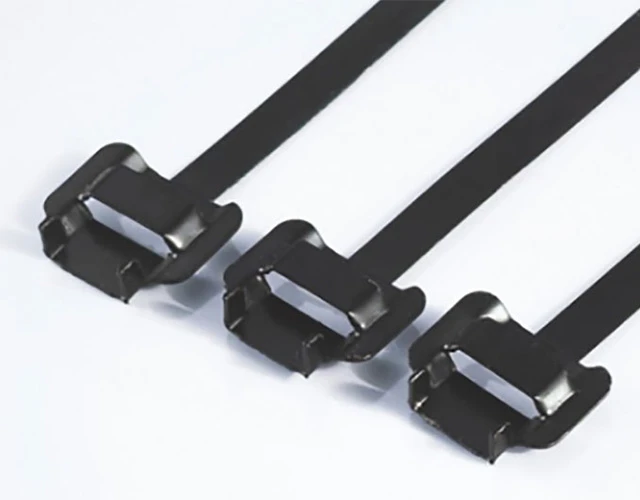
One hesitation engineers sometimes voice is whether the coating compromises loop tensile strength. The answer depends on the coating material and, more critically, the locking mechanism. Polyester coatings have a low coefficient of friction; in a poorly designed ball-lock head, that can reduce grip. Reputable suppliers compensate by tuning the tooth geometry or by using a coated ball bearing, ensuring rated tensile strength matches the uncoated equivalent. In correct applications, a coated 304 tie can achieve the same minimum loop tensile strength—often 100 to 250 lbf for standard widths—as its naked counterpart.
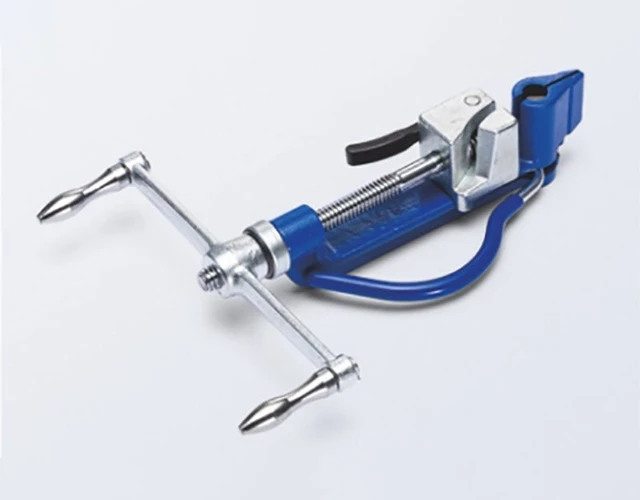
Installation is where things can go wrong. Using a generic pliers-type tool that isn’t adjusted for coating thickness may cut or tear the jacket at the tensioning point. A clean installation requires a tool with smooth-contact surfaces or one specifically calibrated for coated ties. This isn’t a limitation of the product; it’s an installation discipline that field teams adopt once they’ve seen coating damage lead to premature corrosion.
If you map application spaces onto a simple matrix of exposure and consequence, the lines become clear.
Choose coated ties when:
The installation faces salt spray, acid fumes, alkaline cleaners, or constant condensation.
Cables are bundled outdoors without additional shelter—solar farms, telecommunications towers, bridge cable trays.
You’re tying dissimilar metals and want to prevent galvanic corrosion at the contact point.
The work site is difficult to access, and the cost of rework far outweighs the per-tie cost.
Naked ties still hold their ground when:
The environment is dry and climate-controlled, such as indoor data center overhead trays.
The application requires resistance to sustained high heat above 150°C, where a coating may degrade.
The project demands magnetic detection of any detached tie tails in food or pharmaceutical processing (though detectable coatings exist, this often steers specification back to bare metal).
Budget constraints are tight and the risk of corrosion is genuinely negligible.
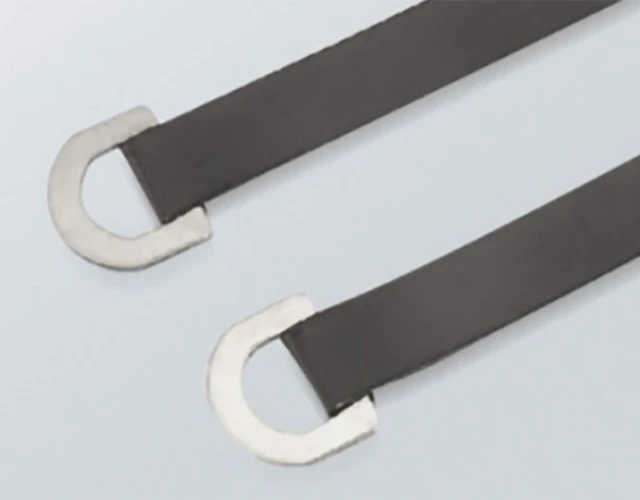
| Feature | Naked Stainless Steel Tie | Polyester Coated Tie |
| Base material | 304 / 316 SS | 304 / 316 SS core |
| Surface protection | Passive chromium oxide layer only | Thermoplastic polyester jacket |
| Salt spray resistance (ASTM B117) | 200–1,000 h depending on grade | Typically >1,500 h |
| UV resistance | Excellent | Excellent (polyester grade) |
| Max continuous operating temp | ~300°C (grade dependent) | ~150°C (limited by coating) |
| Relative cost | Lower | 20–50% higher per tie |
| Typical use | Indoor cable trays, temporary bundling | Offshore, chemical plants, outdoor solar, marine |
The decision between coated and naked steel ties isn’t a contest of good versus bad. It’s a question of whether the five-to-ten-year cost of a minor materials upgrade is worth eliminating a whole class of failure modes. In hundreds of post-installation audits across coastal infrastructure, the pattern is consistent: sites that opted for uncoated stainless steel cable ties within the splash zone saw visible degradation within three years. Those that invested in a polyester-coated alternative showed cosmetic dirt at worst over the same period, with zero structural replacements.
If you’re already specifying stainless steel cable ties and are bumping up against corrosion limits, switching to a coated version is a pragmatic next step rather than a complete redesign. The base mechanical properties remain the same, and your installation crews work with the same toolset after minor adjustment. The main shift is in inventory management—stocking one more SKU—but the reduction in call-backs and secondary damage repairs generally offsets that within the first maintenance cycle.
For teams evaluating long-life fastening in aggressive environments, ETL's polyester-coated tie series is engineered specifically to combine the tensile reliability of stainless steel with a high-bond polyester jacket that resists chemical attack and UV degradation. Instead of mixing and matching uncoated ties with messy field-applied protective tapes or sleeves—a workaround that rarely outlasts a single season—an integrated coated design keeps both the tie body and the locking head protected through the entire service life.


 中文
中文 English
 Pусский
 Français
 Español