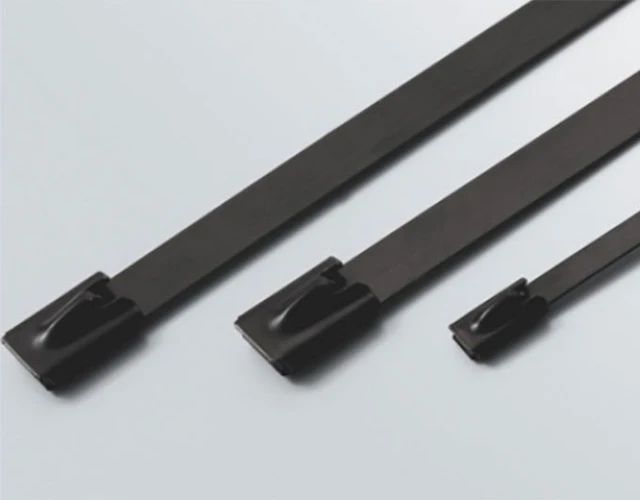
A routine inspection on a North Sea gas platform revealed something the maintenance team had been dreading. Bundles of instrumentation cable, secured to stainless steel tubing just two years earlier, were sagging dangerously. The black nylon-coated ties had turned brittle and cracked, but that wasn’t the real threat. Under the cracked coating, the carbon steel core had been reduced to a rusty stain, eating into the tube surface where the two metals touched. The culprit was galvanic corrosion—and the supposedly protective coating had become the failure’s enabler.
That event, shared during an industry corrosion forum, encapsulates a dilemma engineers face in chemical plants, offshore wind farms, and coastal substations: when you clamp a cable to a pipe or structure, you are creating an accidental battery. Dissimilar metals + electrolyte (moisture, salt spray, process fluid) = ion flow. The less noble metal becomes an anode and sacrifices itself, often in a matter of months. Coated steel ties are the classic, cost-conscious answer to this problem—and they work, if you understand exactly how the protection mechanism functions, and when it doesn't.
A galvanic cell needs three elements: an anode, a cathode, and a metallic path for electrons between them, plus an ionic path through the electrolyte. Coated steel ties attack the metallic path. The nylon, epoxy, or PVC layer acts as a dielectric barrier that physically separates the two metals. As long as that coating is intact, there is no electrical continuity where the tie touches the pipe, so the galvanic circuit cannot close. In addition, some modern coatings are formulated with corrosion inhibitors that passivate any microscopic discontinuities at the steel-coating interface.
This is why, for indoor or mildly corrosive environments, coated steel ties can be a perfectly functional choice. They are widely specified according to standards like ASTM A153 for zinc coatings or UL 62275 for cable management accessories, and they keep upfront material costs low. Installers appreciate the familiar tooling, and the thick profile feels robust. But surface durability is only one part of the equation. In any real-world application, the tie’s internal contact with the bundle—and the coating’s resistance to handling damage—determines whether the barrier survives the first year.

The problem with a barrier-only approach is that it depends 100% on the barrier staying perfect. Yet the act of tensioning a tie during installation generates friction and local pressure that can breach the coating at microscopic edges. Thermal cycling, UV degradation, and impact from debris or foot traffic create craze marks that become paths for moisture ingress. Once the coating is compromised, the geometry of a tie works against you: a large area of cathode (stainless steel pipe or cable tray) couples with a very small area of anode (exposed steel spot under the coating). This unfavorable cathode-to-anode ratio accelerates local corrosion aggressively, sometimes causing pitting of the host structure rather than just the tie itself.
Maintenance teams in a Gulf Coast LNG facility reported that coated steel ties used on duplex stainless steel pipework showed average failure initiation after only 14 months—despite a manufacturer’s coating warranty of five years. The root cause was not the coating material but the micro-impacts from foot traffic on walkway-adjacent cable runs. When the tie fails, the repair cost far exceeds the tie’s unit price, especially when it involves scaffolding or process shutdowns. This is the inflection point where material selection shifts from "adequate barrier" to "inherent immunity."
If the coating is the only thing preventing galvanic corrosion, every scratch becomes a risk. An alternative approach is to eliminate the galvanic couple entirely by choosing a fastener that is already close in potential to the structure it contacts—or one that forms its own self-repairing passive layer. This is where solid, corrosion-resistant fastening options come into the picture. For instance, when securing cables to stainless steel trays or pipes, specifying a tie that itself resists corrosion removes the reliance on an external barrier. One material that frequently enters the specification conversation is stainless steel cable ties, particularly the 316 grade for marine and chemical exposure. Unlike coated carbon steel, they do not need a coating to break the electrical path; the passive chromium oxide film naturally inhibits localized corrosion even if the surface is scratched, provided the grade is matched correctly to the environment.
To make a confident selection, engineers usually look at the pitting resistance equivalent number (PREN = %Cr + 3.3×%Mo + 16×%N) and ensure the tie’s PREN value aligns with the connected metal’s nobility. This kind of analysis shifts the decision from “will the barrier hold?” to “is the material system thermodynamically stable?” The difference in lifecycle becomes apparent once you map the failure modes side by side:
| Failure Factor | Coated Steel Tie | Inherently Corrosion-Resistant Tie (e.g., 316 SS) |
|---|---|---|
| Primary protection mechanism | Dielectric coating barrier | Self-passivating oxide layer |
| Impact of coating damage | Immediate galvanic cell formation | No coating needed; scratch self-heals in oxygen |
| Cathode-to-anode area risk | High (small exposed steel spot) | Negligible (uniform corrosion rate) |
| Typical service life in C5-M marine | 2–4 years with pristine coating | 20+ years when grade-appropriate |
| Maintenance action after damage | Full replacement recommended | Usually continues to perform |
This comparison isn’t about declaring one product category universally superior—it’s about matching the fastener to the asset’s criticality. In a low-consequence indoor control cabinet, a coated tie is a rational cost trade-off. On a flare boom or a cable tray over seawater intake, the economics invert. The cost of a single unplanned shutdown often justifies the entire fastening budget for a project. Because of this, more engineering specifications are starting to mandate fastening solutions that don’t depend on a barrier layer.
If you are looking for fastening products engineered to survive such environments without relying on an external shield, ETL’s range of anti-corrosion bundling solutions is built around this very philosophy. The product family was developed specifically for asset owners who want to eliminate the maintenance loop triggered by coating degradation.
Switching from a barrier-protected tie to one made from intrinsically corrosion-resistant material does require a few engineering checks. First, verify the alloy compatibility between the tie, the clamped cables (especially if they have metallic armor), and the support structure. Most design guides, such as NORSOK M-001 for offshore applications, provide galvanic series charts that help avoid accidental pairings. Second, consider mechanical load. While solid corrosion-resistant ties offer high tensile strength, their elongation characteristics differ from polymer-coated types, so the tightening method should be adjusted—manual or calibrated torque tools avoid excessive slack or over-stress. Third, for applications where stray electrical currents are present (such as near DC traction systems or impressed current cathodic protection), a full isolation strategy may still be needed, although the base material’s inherent corrosion resistance adds an extra safety margin.
Project teams that document these checks during the detailed design phase rarely encounter surprises. A pharmaceutical plant in Singapore, after recurrent coating failures on pipe-mounted cable bundles, migrated to a specification based on permanent corrosion-resistant fasteners and recorded zero tie-related corrosion findings in the next three inspection cycles. The team also found that because the chosen ties were fully non-magnetic and offered cleanroom-compatible surface finishes, they could standardize on a single specification across multiple process areas. That kind of simplification lowers the overall total cost of ownership in a way that a per-unit cost comparison completely misses.
Coated steel ties prevent galvanic corrosion by being a physical separator. That’s a valid, well-understood mechanism. But like any separator, it is only as reliable as its continuity. If your asset integrity strategy tolerates periodic inspection and replacement, they may fit perfectly. If you need a tie that performs long after the coating in the same installation would have micro-cracked, it’s worth evaluating a fastening strategy where the corrosion resistance is built into the material itself, not wrapped around it.
To see how this shift in thinking translates into specific product choices, you can explore ETL’s dedicated selection of high-durability cable ties and access technical data that includes alloy composition, PREN values, and independent salt spray test results per ASTM B117.
Disclaimer: The corrosion performance data mentioned in this article are based on publicly available studies and third-party test reports. Actual service life depends on specific environmental conditions, installation practices, and material compatibility. Always consult manufacturer data sheets and a qualified corrosion engineer for critical applications.


 中文
中文 English
 Pусский
 Français
 Español