A maintenance engineer at a coastal wastewater treatment plant recently shared a frustration that might sound familiar. Every six months, the stainless steel ties securing critical sensor cables above the aeration basins would show pitting and rust staining—despite being sold as “marine grade.” Nearby, a set of plastic ties installed three years earlier for a temporary repair were still holding firm, with no visible degradation. The experience forced a complete rethink of what “harsh environment” actually means for fastening components.
The truth is, there is no universal champion when you’re securing cables, conduits, or hoses in aggressive conditions. The choice between metallic and polymer-based fastening systems depends entirely on a combination of chemical exposure, temperature cycling, mechanical load, UV radiation, and even installation ergonomics. To make the right call, you need to break the problem down into measurable performance factors rather than relying on material reputation alone.
Before comparing materials, it’s worth mapping the specific stressors your installation will face. A harsh area could be any combination of the following:
Chemical attack: Acids, alkalis, salt spray, hydrocarbons, or cleaning agents.
Thermal extremes: Sustained heat above 80°C or deep cold below -40°C.
UV and weathering: Continuous outdoor exposure with wide temperature swings.
Mechanical vibration and shock: Heavy equipment, wind-induced oscillation, or surge loads.
Safety and certification demands: Flame retardancy, low smoke toxicity, or halal and food-contact approvals.
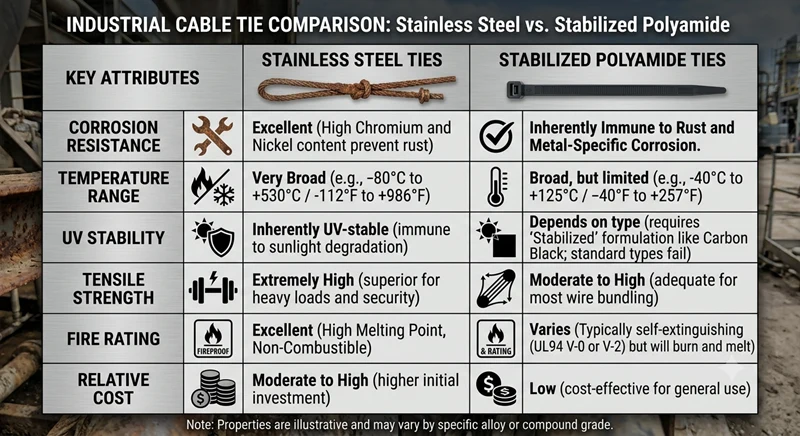
Mistaking one stressor for another is what leads to premature failure. For instance, stainless steel excels in high heat but can be destroyed by chloride-induced stress corrosion cracking in marine or chemical environments. Polymer-based ties avoid that corrosion entirely but may soften under sustained heat loads. The key is matching the material’s tolerance envelope to your real operating window.
When salt spray, caustic cleaning solutions, or acidic vapors are present, metallic ties—even 316 stainless steel—are in a constant battle against localized corrosion. Pitting, crevice attack, and chloride stress cracking can turn a seemingly robust metal tie into a brittle failure point within months. In these scenarios, high-quality polyamide 6/6 ties offer a genuinely inert alternative. According to ASTM D6779, the standard covering polyamide fastening devices, properly manufactured ties resist most alkalis, hydrocarbons, and organic solvents, making them the default choice in chemical plants, offshore platforms, and coastal installations.
However, not all synthetic ties are equal. Heat-stabilized and UV-stabilized grades are essential for outdoor exposure, otherwise the polymer can degrade from ultraviolet radiation and thermal oxidation. Before committing to a large-scale deployment, it’s prudent to review real-world case studies or validated test data from manufacturers. If you’re evaluating reliable fastening methods for corrosive environments, comparing independent salt-spray test results (per ASTM B117) for both material families can provide an objective basis for your specification.
Temperature resistance is where the material families diverge sharply. Stainless steel ties routinely handle continuous temperatures exceeding 500°C, making them irreplaceable in exhaust systems, furnace instrumentation, and fire-rated structural applications. Standard polyamide ties, by contrast, typically have a continuous operating temperature range from -40°C to 85°C, with a melting point around 260°C. For most industrial electrical installations and outdoor bundling work, that window is perfectly adequate.
Where polymer systems have evolved is in fire behavior. Certified flame-retardant grades meeting UL 94 V-2 or V-0 classifications are widely available, and some specialty ties comply with railway interior fire standards such as EN 45545-2. These aren’t just “plastic” products; they’re engineered compounds designed to self-extinguish and limit smoke toxicity. For indoor public infrastructure, data centers, or rolling stock, the fire performance of modern synthetic ties often matches or exceeds that of uncoated metal ties that lack insulation and can transmit heat dangerously. When your application demands synthetic fasteners with UV and moisture resistance plus a defined fire rating, look for documentation that cites the specific UL or EN test methods used, not just a generic “flame retardant” claim.
A common assumption is that metal equals stronger. That’s only partially true. High-quality 316 stainless steel ties offer superior tensile strength and stiffness, but their failure mode can be sudden and catastrophic. Polyamide ties, on the other hand, exhibit a more ductile failure—they stretch before breaking, providing a visual warning of overload. This is a significant safety advantage in bundling where shifting loads are expected.
Under sustained vibration, metal ties can work-harden, become brittle, and snap, especially if they’ve been overtightened or scored during installation. Polymer ties have inherent damping characteristics and maintain their flexibility over millions of micro-movements. The critical specification to check is the minimum tensile strength per the relevant standard, such as the loop tensile strength test in ASTM D6779. For outdoor installations subject to wind and dynamic loads, choosing non-metallic fastening solutions for outdoor installations with a documented safety factor of at least 3:1 is a common engineering practice.
Field crews know that metal ties come with a hidden cost: lacerations. The trimmed tail of a stainless steel tie becomes a razor-sharp hazard, requiring protective gloves and careful dressing to meet site safety rules. Polymer ties cut cleanly with standard snips and leave no sharp edges, speeding up installation and reducing injury risk.
From a total-cost perspective, stainless steel ties carry a significantly higher unit price, but that may be justified in high-temperature or high-security applications where no polymer can survive. For the vast majority of outdoor electrical, instrumentation, and general industrial bundling tasks, a UV-stabilized, flame-rated synthetic tie provides a more cost-effective route that avoids corrosion replacement cycles entirely. If your project involves solar farms, water treatment, or coastal infrastructure, it’s worth examining ETL’s selection of durable fasteners to understand what material and certification package fits your maintenance strategy.
Rather than asking “which material is better,” ask these five questions about your installation:
What is the maximum continuous temperature the tie will experience, not just the ambient air temperature but the surface temperature of the bundle?
What chemicals will contact the tie during normal operation, cleaning, or accidental spill events?
Is UV exposure constant (as in direct sunlight for 10+ years) or intermittent?
What tensile strength do you genuinely need, including a safety margin for dynamic loads?
What fire performance certification is mandated by local code or your project specification?
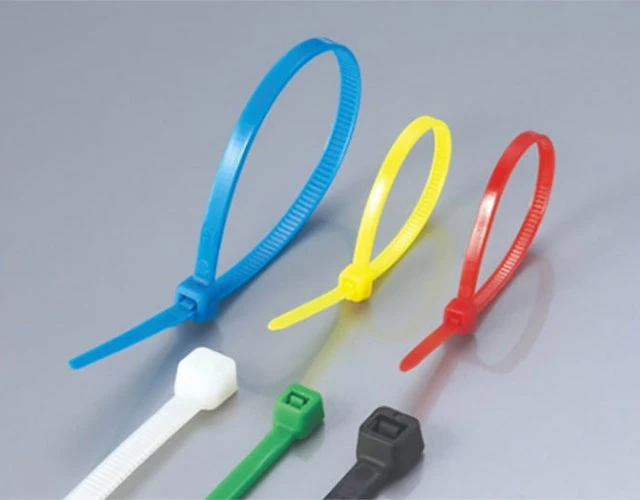
Answering these questions eliminates about 90% of mis-specifications. In most cases where temperatures stay below 85°C and corrosion resistance is the dominant requirement, a high-spec polyamide fastening system becomes the logical choice. The original Nylon Cable Ties that entered the market decades ago have evolved into highly engineered components that meet stringent industrial standards—the difference lies entirely in whether you select a generic commodity product or a documented, certified solution.
When you’re navigating these trade-offs, having access to clear technical datasheets matters. Many installers initially choose metallic ties out of a “better safe than sorry” instinct, but end up back on site replacing corroded units long before the equipment itself requires maintenance. Shifting the selection logic toward matching material chemistry to environmental chemistry often leads to a simpler, longer-lasting outcome. Nylon Cable Ties designed with proper stabilization packages have repeatedly demonstrated decade-long service lives in coastal solar installations and wastewater plants, with lower replacement frequency than stainless alternatives in chloride-heavy environments.
For critical infrastructure, the weak link isn’t usually the material itself—it’s the lack of verification. Request batch-specific test certificates that confirm compliance with ASTM D6779 loop tensile strength and, if applicable, UL 62275 for cable management systems. When working with metallic ties, request mill certificates verifying 316 or 316L grade chemistry, not just a magnetic check.
Third-party testing data from organizations like TÜV or SGS can add an extra layer of confidence, especially when your installation falls under a regulated code. A recent independent comparison of Nylon Cable Ties for outdoor electrical enclosures found that UV-stabilized, black polyamide 6/6 ties retained over 90% of their tensile strength after 5,000 hours of Xenon-arc weathering (per ASTM G155), whereas non-stabilized natural-colored ties lost over 50%. That single variable—stabilization—matters more than the material family in many cases.
If you’re looking for a fastening system that aligns with rigorous environmental and certification requirements, it’s worth taking a closer look at what engineered polymer solutions can offer today. You can explore ETL’s range of corrosion-resistant fasteners to see specific product specifications, material datasheets, and application guides that help bridge the gap between generic component selection and documented engineering assurance.


 中文
中文 English
 Pусский
 Français
 Español